Robotics viewers replay one recording. omxplorer starts from a question across the whole fleet, then shows you the moment. A million rows answer in under a millisecond on your own GPU, and every button is a tool your AI agent can call.
Why did the robot drop it? 63,344 real robot episodes from 13 labs, their video and 16.8M telemetry rows, linked by key and time. A question in words over every row in about 40 ms.
↳ DROID (CC-BY-4.0) · omxcode docs/goals/47-report.md
NVIDIA RTX 3090 · the repo's own checks re-run each number · honest edge: a 100M-row median chart takes about 0.7 s (0.77 s in goal 30)
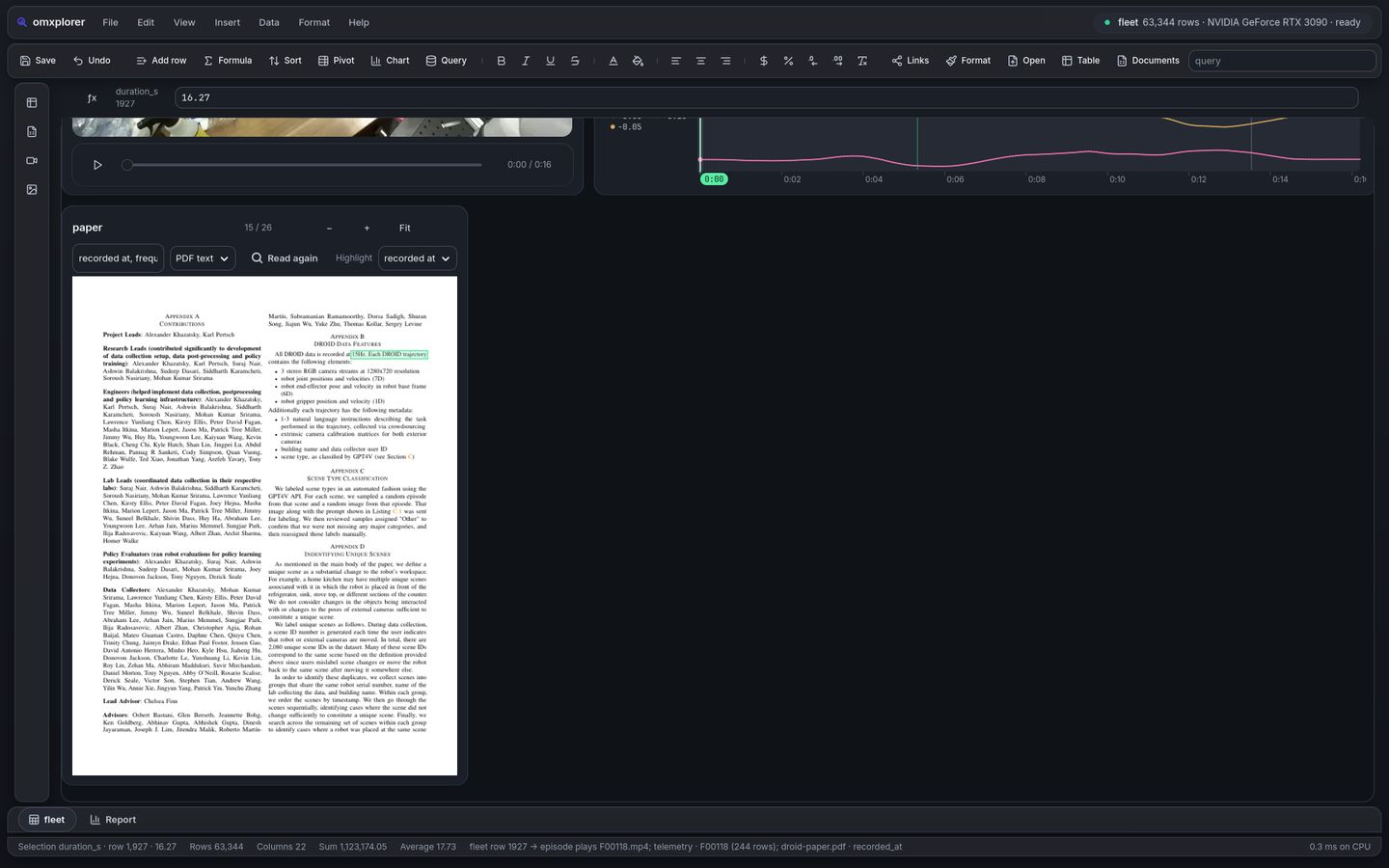
The whole fleet is a spreadsheet you touch: 63,344 real episodes from 13 labs (DROID, CC-BY-4.0), pivots and charts from a sentence. Ask in words over all 16.8M telemetry rows in about 40 ms, with no Python and no server, then tap an answer: its video and telemetry open on one cursor, its documents linked.
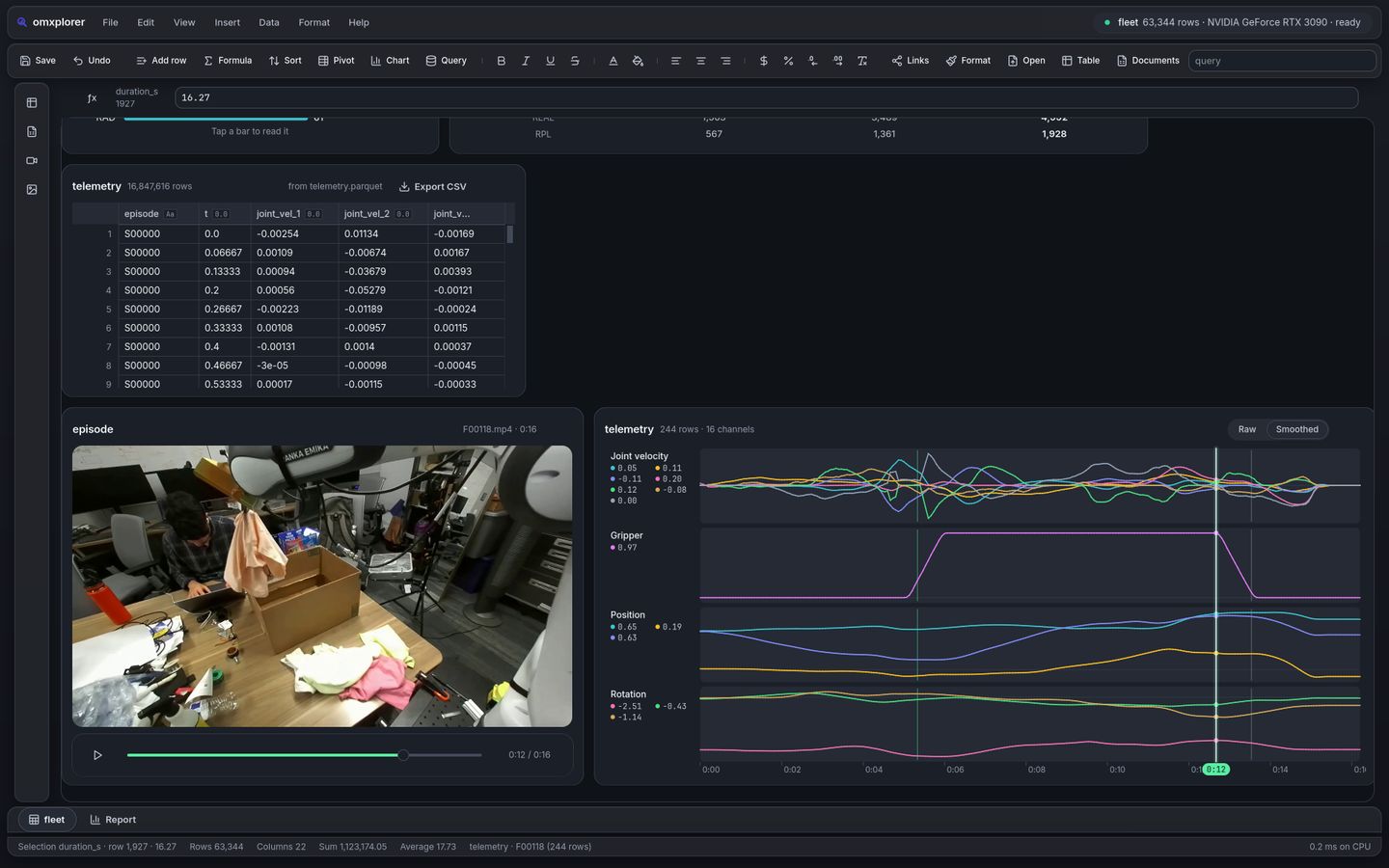
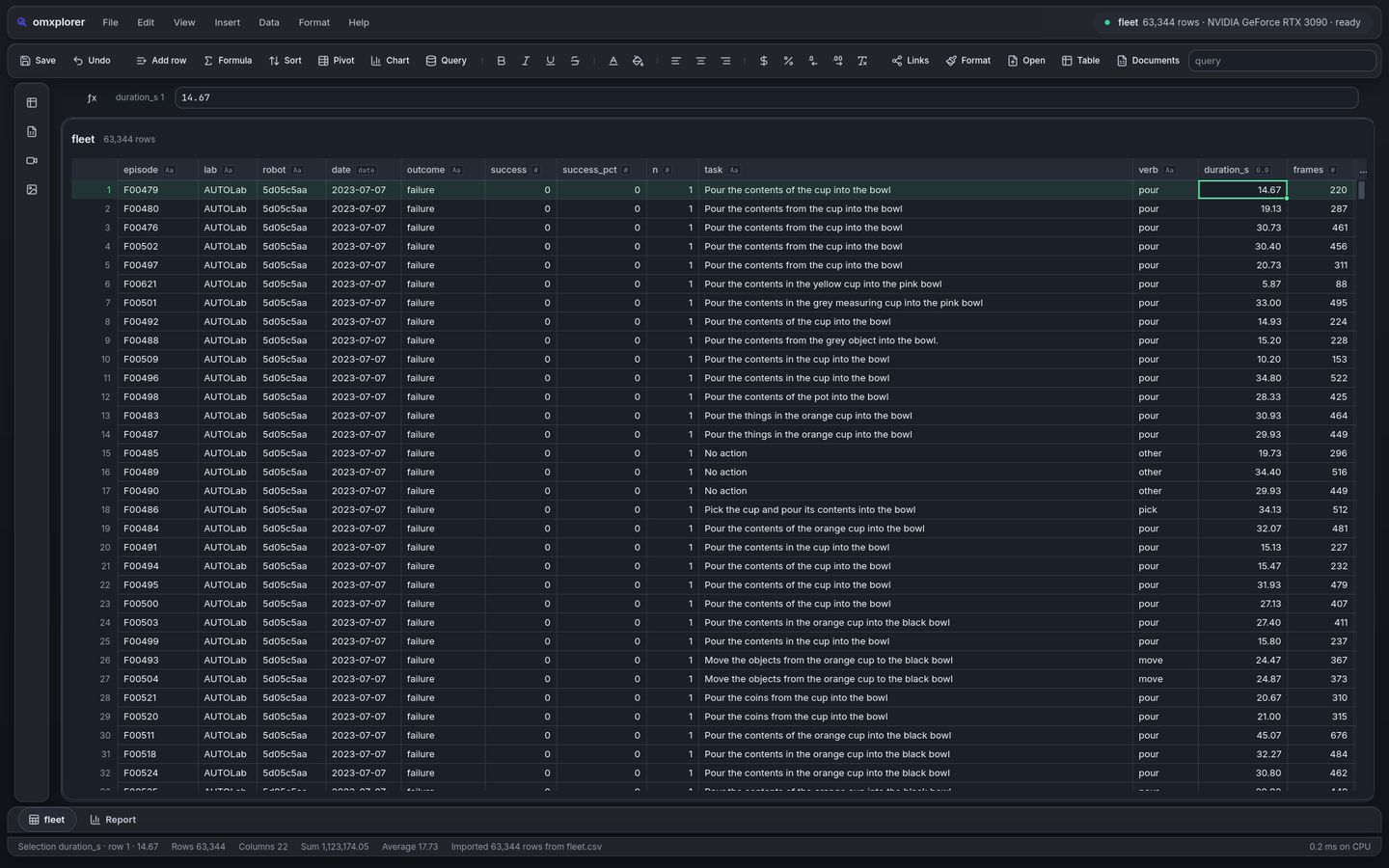
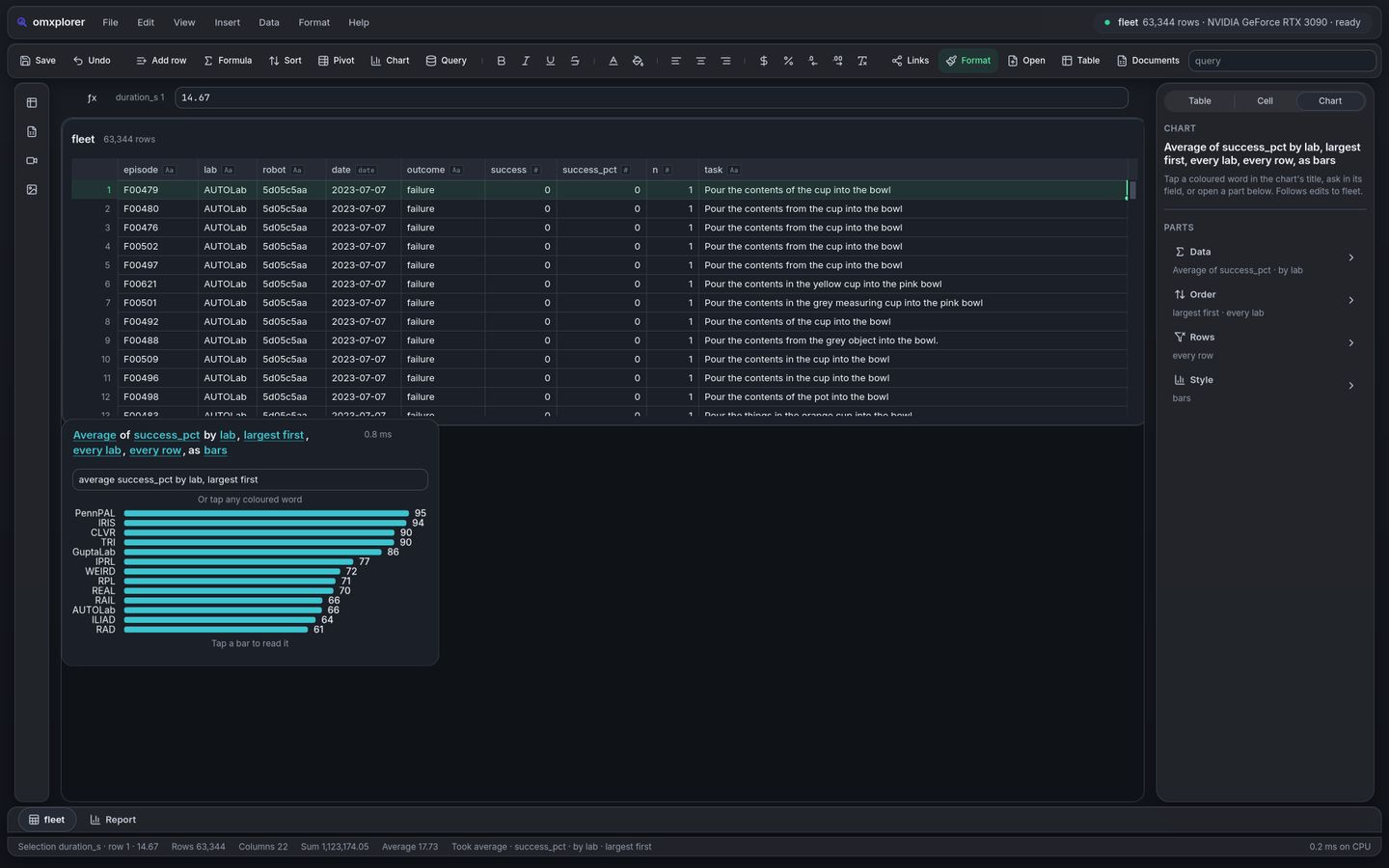
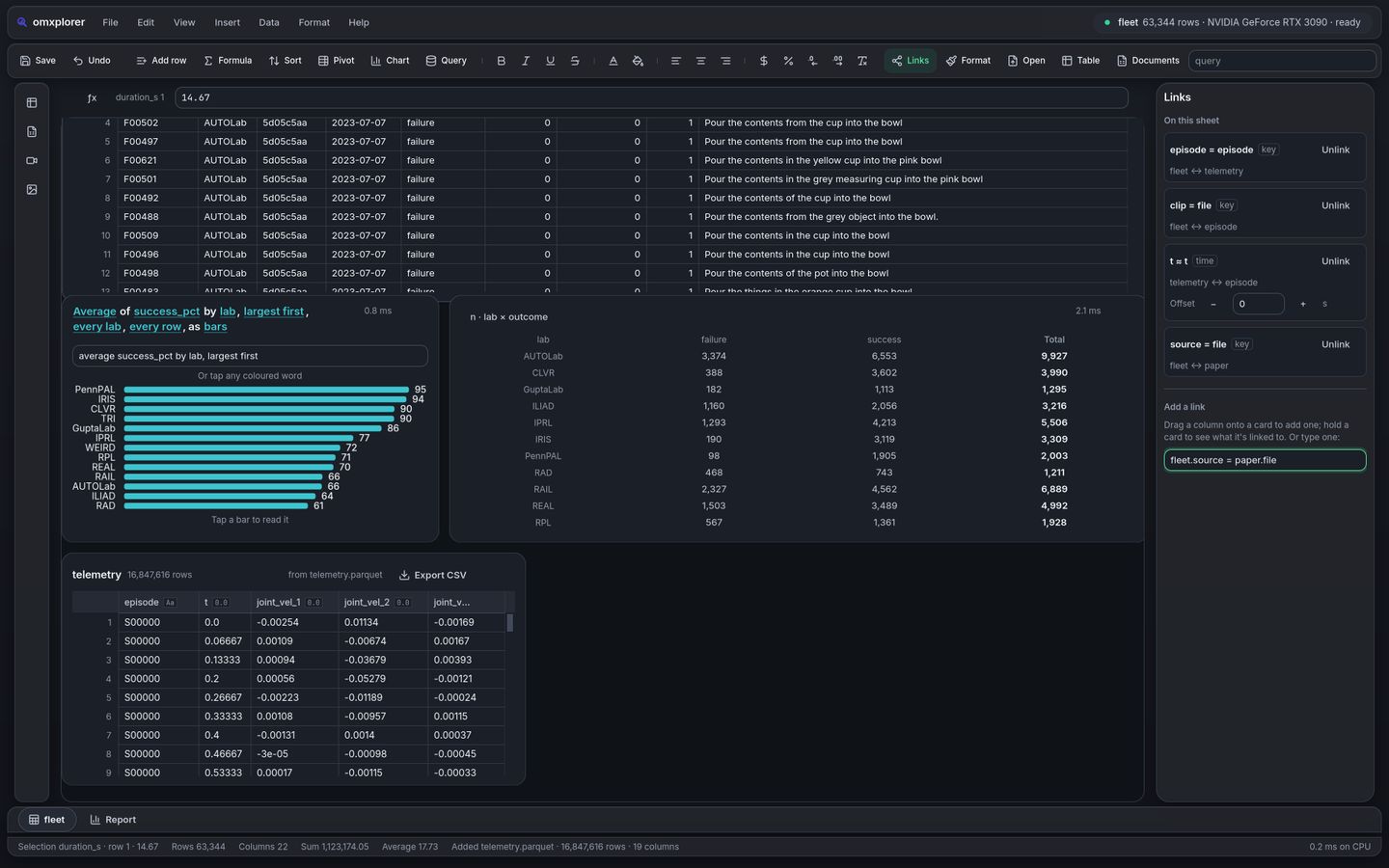
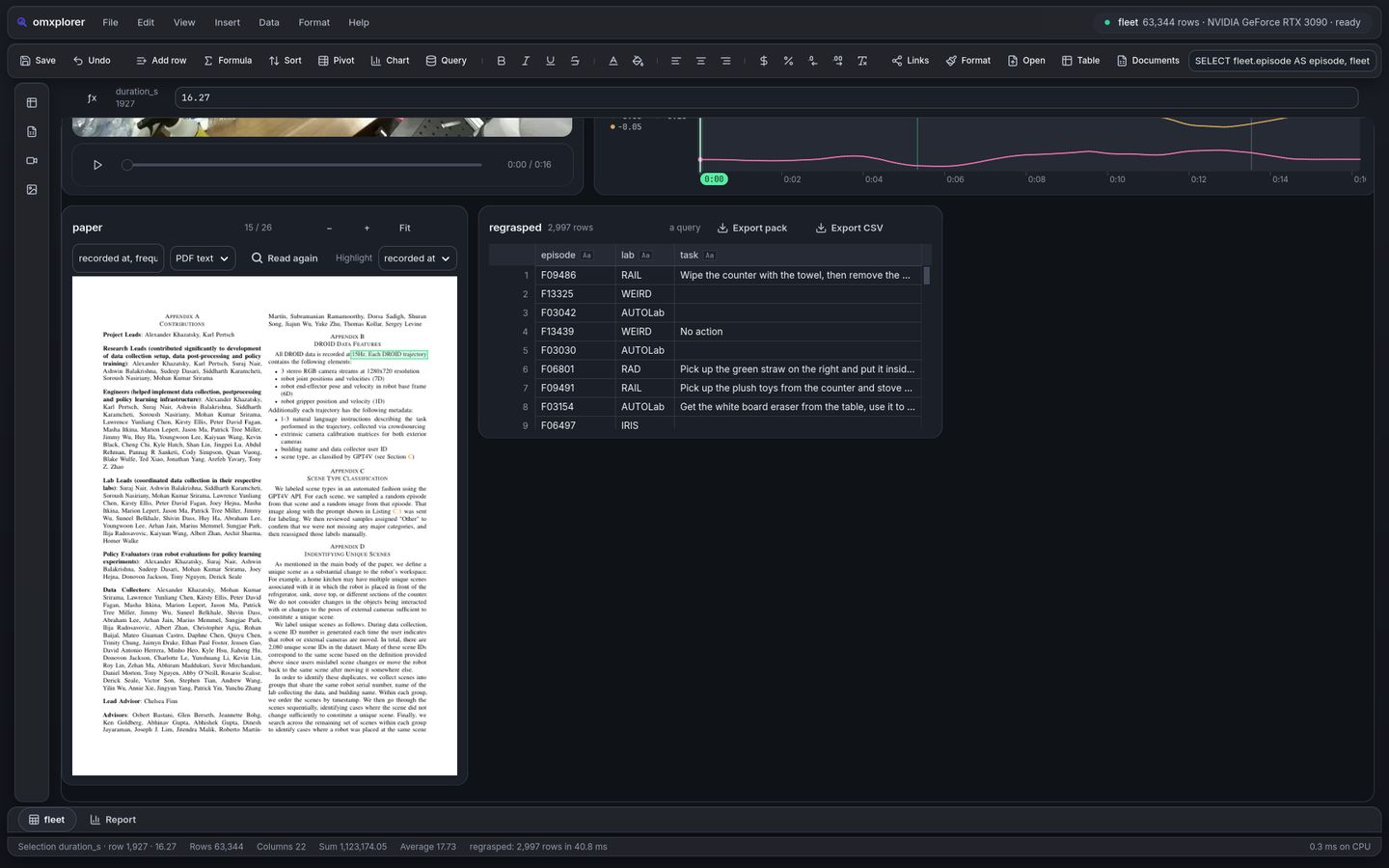
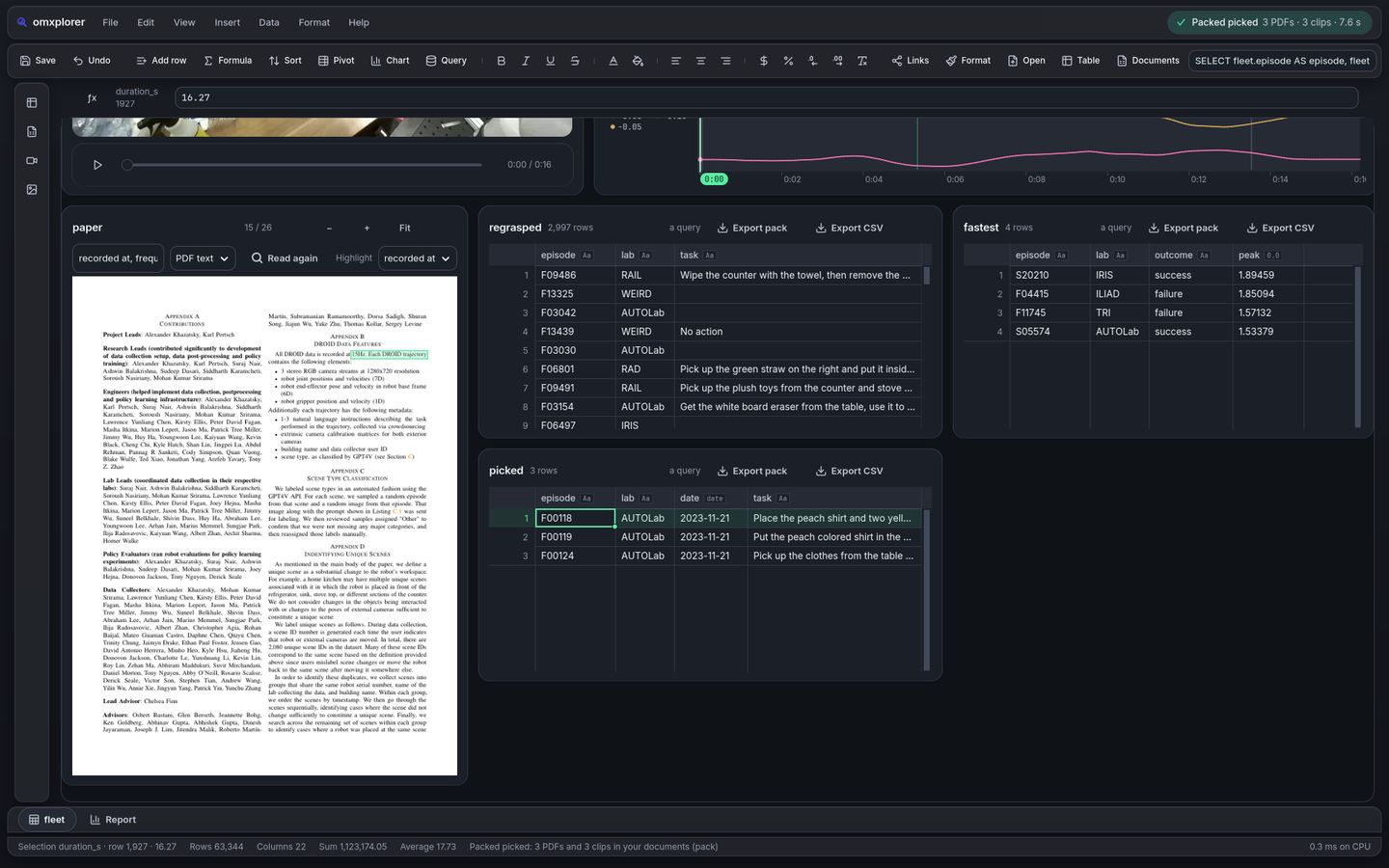
What the data doesn't support: DROID has no force or torque, so "dropped" is read from the gripper and the video; the per-episode gripper features don't predict failure across labs, so they're filters, not a detector · omxcode docs/goals/47-report.md
Robotics viewers replay a recording. omxplorer starts from a question across the whole fleet, then shows you the moment.
No schema written in code. Drag a column onto a card and say yes. Nothing joins until you link it, and a question uses only the links you made, so every answer can show where it came from.
Pivots, charts from a sentence, formulas and edits, over every run.
Ask in words over 16.8M rows (~40 ms), tap an answer row, and its video and telemetry open on the same cursor.
A manual or paper linked by key, with the passage marked.
The query runs in the app's process, on your GPU.
16.8M telemetry rows · 37–42 ms in the check's runs · links, documents and the pack: omxcode docs/goals/47-report.md
“Sum of revenue by product, top 5, as bars.” Every coloured word is a setting. Tap one, or type “median”, and the bars move to the new answer.
omxplorer is an MCP server from the first line. An agent calls what a person can tap, and nothing more.
Group-bys, medians and charts run as GPU kernels in omxcore, linked in like SQLite.
Open CSV and Parquet straight from disk. Big files stream in, so the first rows show in 0.2 s.
Linux and the web run today, and the Mac runs on CI Macs (GitHub's macOS runners), from the same Mojo. Phones are next.
Sum of revenue by product, largest first, top 5, as bars
Most apps meet AI agents through screenshots and guesswork. In omxplorer, every control your hands can reach, an agent can call. A disabled button is no tool.
→ choose-a-file {"path": "orders_1m.csv"} → create-table → insert-chart → ask {"text": "revenue by product, largest first, top 5"} ← Now: chart0: 0.6 ms
Open a video and it turns into a table you can ask, like any CSV: about 400 frames a second, on your GPU. Ask for a reel, and the rows cut it.
The dock camera, the shipments sheet and the signed bills of lading answer one question: which damaged pallets does the carrier owe for? You link them yourself, then pick any answer to see its proof.
JOIN LINKED uses only the links you made.Press Play to follow a failure from the sheet to the moment the shirt falls, or click any block to read what it does.
The fleet sheet, its video, its 16.8M telemetry rows and the DROID paper, joined only by the links you confirm; omxcore answers questions over them in the same process.
Data and robotics first, then every screen. Each step ships when its checks pass.
Sheets, pivots, charts from a sentence over 100M-row files; video becomes rows; the claim; the robot story. Linux, the web, CI Macs.
runs today3D scenes, MCAP and ROS bags, more cameras per episode, beside the fleet sheet.
nextomxplorer live on omxlabs.tech (hosting not set up yet); OWLv2 and SAM 2.1 inside omxplorer; Ask answered by omxconsole on your GPU.
nextShare an investigation with a team; audio becomes rows; real-world footage at scale; Apple GPUs on real Macs (CI Macs today).
plannedClick the slides, then use the arrow keys. Code steps line by line; the architecture moves as a tap runs.