Ask your data in a sentence.
A data workspace where a million rows answer in under a millisecond, on your own GPU, and every button is a tool an AI agent can call.
arrow keys, space or swipe · 18 slides, about two minutes
Data tools make you wait, and make agents guess.
You wait.
Spreadsheets choke past a million rows. Warehouses answer in seconds and send a bill.
Agents squint.
AI agents drive apps through screenshots and pixel coordinates. It's slow and it breaks.
Your GPU naps.
Most workstations have one. Data apps leave it idle while the CPU struggles.
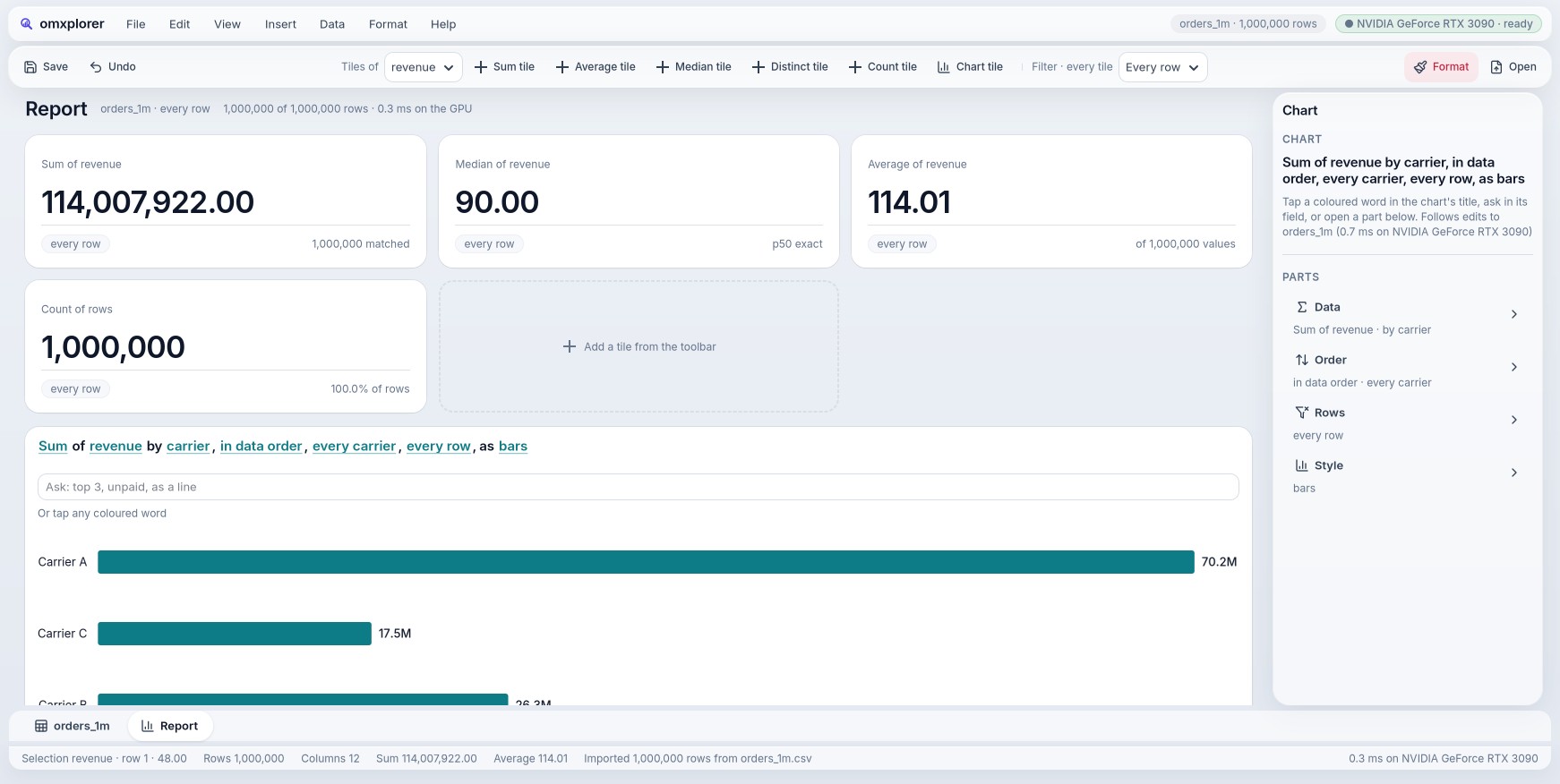
Numbers and Power BI, on the GPU.
Sheets, pivots, charts and reports over your CSV and Parquet files.
About 2,100 lines of Mojo, built from omxcode's components, run by omxcore.
a million orders, every tile recomputed in 0.3 ms · RTX 3090
The title is the chart.
Sum of revenue by product, largest first, as bars
Tap Sum, pick Median.
Median of revenue by product, largest first, as bars
a median per group over 1M rows: 6.4 ms on the GPU · omxcode README
One language, from the button to the GPU kernel.
all Mojo: no Python, no JavaScript framework, no C++ in the middle
You tap “Median”. 6.4 ms later, new bars.
No round trip. The engine is linked into the app, like SQLite.
No copy, on Linux. GPU frames go straight to the window (saves 4–5 ms a frame).
Just the diff. The host patches the native widgets that changed.
An app is a struct: state, update, view.
struct Main(App):
    var name: String
    var clicks: Int

    def update(mut self, event: Event):
        if event.message == GREET:
            self.clicks += 1

    def view(self) -> View:
        var greeting = "Hello, " + self.name + "! (click " + String(self.clicks) + ")"
        return VStack(
            Text(greeting, style=TITLE),
            Button("Greet", on_tap=GREET, style=PROMINENT),
            spacing=20,
        )
the same file opens on Linux (GTK) and the web, and on CI Macs; Android on the emulator; iPhone builds
Words are buttons. Buttons are tools.
Sentence([Word("Sum", ASK_COMBINE, "word-combine"), Word(" of "), Word("amount", ASK_VALUE, "word-value")])

for w in words:
    if w.msg != NO_MSG:      # a token: tap it to see its choices
        line.append(Button(w.text, w.msg, TOKEN).tag(w.tag))
    else:                    # plain words: " of ", ", "
        line.append(Text(w.text, style))
# a tag names the button; the agent host turns every tagged button into an MCP tool,
# so "word-combine" is something a person taps and an agent callsFast enough that you stop waiting.
a chart over 1M rows
a frame, scrolling a 1M-row grid (p95)
20M points in one frame
to open a 100M-row file, streamed
RTX 3090 · the repo's own checks re-run each one · honest edge: a 100M-row median chart takes about 0.7 s
A dashboard over 100M rows: 30 ms a click.
median, measured at 856a7e9, before the release build · docs/data-benchmark.md
goal 38 · median of medians, p95 49.1 ms · Rust + Polars + egui · JS + FastAPI + Polars · JS + DuckDB-WASM · docs/data-benchmark.md
Every button is a tool.
No screenshots, no coordinates. A button's tag is its tool's name.
The screen is the permission model. A disabled button is no tool. A dialog's buttons exist only while it's open.
One sentence for both. The words you tap are the words the agent asks.
a real session · omxcode README, docs/agent.md
Written once. Native everywhere.
Mac: GitHub's macOS runners · Android: the emulator · iPhone compiles and signs, hasn't run on a phone yet · the GPU: NVIDIA on Linux, Metal on CI Macs
A video becomes rows, 400 frames a second.
the warehouse: rows → a reel, faces blurred, ID burned in
the drone: what got worse → the next flight plan
Frames in, rows out. Then it's just data.
One slot, two engines. Classic GPU vision today; a model plugs into the same place and gives the same rows.
Rows are rows. "Delivered, but the label never shows on camera" is one SQL join.
Every step is a tool. Analyze, Make a reel, Cut it: an agent calls what you tap.
A video, a sheet and the paperwork answer one question.
which damaged pallets does the carrier owe for?
You make the links. Drag a column onto a card and confirm. Nothing joins until you do.
Documents become rows. The OCR runs locally, inside the app.
Every answer shows its proof: the frame with the damage, and the page with "Exceptions: None".
Tap one example. It finds the rest.
recall on the damaged frames
precision
to scan the 1,140-frame warehouse
on our generated footage, scored against its truth · RTX 3090 · models run on Linux + NVIDIA only, for now
From tables to every kind of data.
- Sheets, pivots, charts, reports
- The sentence chart
- 100M-row files, streamed
- Agent host (MCP)
- Video becomes rows; the reel; the drone
- Linked evidence: video, sheet, paperwork
- The robot story: 63,344 DROID episodes, 13 labs, 16.8M telemetry rows, a question in ~40 ms
- Try it in the browser
- Ask, answered by omxconsole
- Real-world footage, audio
- Share with a team
- Apple GPUs on real Macs (CI Macs today)
One app. Three technologies under it, local AI beside it.
omxcore
powers it: the GPU engine
omxcode
builds it: write once, native everywhere
omxconsole
local AI, on the same GPU
omxqua
the look: springs and solid surfaces (this site; omxplorer next)
Read on: GitHub · the agent docs · omxlabs